
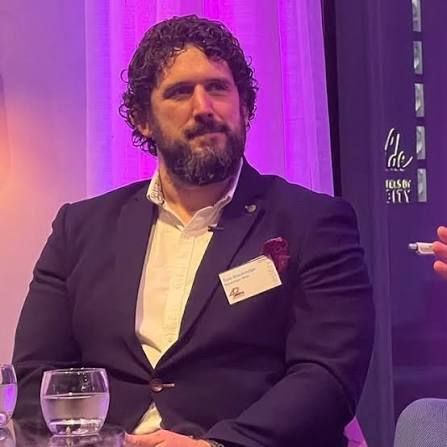
Tom Blackledge on courage, identity, coaching and performing under pressure
A blog and Substack article by Andy Hosgood, Unlock with Coaching
How do you face fear when your mind is racing, your identity is shifting and the outcome matters? Former UFC fighter, coach, author and speaker Tom Blackledge has spent a lifetime exploring that question. His answer is not to become fearless. It is to stop allowing fear to make your decisions for you.
In this episode of the Unlocking Human Potential podcast, Tom joins me for a wide-ranging conversation about fear, resilience, identity, stoicism, curiosity and what meaningful coaching really requires. The lessons come from mixed martial arts, but they reach far beyond the cage. They are relevant to leaders, founders, coaches, parents and anyone trying to move forward when confidence feels less certain than they would like others to believe.
Fearless does not mean fear-free
The title of Tom’s book, Fearless by Design, could easily be misunderstood. It does not describe a person who has eliminated fear. That person does not exist. Fear is a human response, and Tom is refreshingly direct about still experiencing it. The important question is what happens next.
A sudden threat creates an immediate physical reaction. A difficult conversation, a high-stakes presentation, a fight, a business decision or a period of uncertainty can also set the mind racing. We start predicting rejection, failure or humiliation. Before long, we are no longer responding to what is happening. We are responding to a story we have constructed about what might happen.
Tom’s approach is to create space between the stimulus and the response. The initial feeling may be automatic, but the behaviour that follows does not have to be. That pause creates the possibility of choice.
Courage is not the absence of fear. It is feeling fear and still choosing to act well.
For leaders, that distinction matters. Good leadership is rarely about feeling completely ready. It is about noticing the fear, understanding what it is trying to protect, and deciding whether it deserves control of the next action.
The danger of building your identity around achievement
Tom reached one of the biggest stages in mixed martial arts. He fought in the UFC, competed in Japan and trained as part of the Wolfslair team during an important period in British MMA. From the outside, reaching that level could look like the summit. From the inside, it felt surprisingly empty.
The deeper challenge arrived when injury brought his fighting career to an end. A fractured neck forced a transition that stripped away more than competition. It challenged the identity he had attached to being a fighter. If that label was gone, who was he and where did his value come from?
This is not only an athlete’s problem. Leaders experience it when a role ends. Founders experience it when a business is sold or struggles. Professionals experience it through redundancy, retirement, illness or career change. When our worth becomes fused with a title, status or achievement, any change can feel like a threat to the self.
Tom’s way through was to reconnect with something deeper. Fighter was a role. Martial artist was a philosophy of development, service, discipline and character. The role could end without erasing the person.
That is a valuable question for any leader: if the title disappeared tomorrow, what would still be true about you? The answer often reveals the values and qualities that can carry you into the next chapter.
Resilience is built through interpretation, not performance
There is a loud version of resilience that celebrates relentless effort and emotional suppression. Tom offers something more useful. His interest in Stoic philosophy is not about becoming cold or pretending not to care. It is about recognising emotion without surrendering control to it.
That connects closely with emotional intelligence. Self-awareness allows us to name what is happening. Perspective helps us see the situation more accurately. Self-management gives us the chance to choose a response that serves us and the people around us.
Hardship does not automatically make us stronger. It can overwhelm, embitter or diminish us. Growth depends partly on how we process the experience, the support available to us and the meaning we eventually make from it. Tom does not romanticise pain. He does, however, recognise that some of his hardest periods became his most important teachers.
This is resilience with honesty. It acknowledges the difficulty while refusing to let difficulty write the entire story.
Curiosity is a serious leadership discipline
Tom begins from a simple position: I know nothing. It is not false modesty. It is a deliberate refusal to become so certain that learning stops.
As children, we ask why constantly. As adults, success can slowly train that curiosity out of us. Expertise becomes identity. Admitting uncertainty begins to feel risky. Leaders can then start defending what they know instead of investigating what they may have missed.
Curiosity changes the quality of a conversation. Instead of asking, ‘How do I prove I am right?’ we can ask, ‘What experience might have led this person to see the situation differently?’ That does not require agreement. It requires enough humility to understand before trying to influence.
This is especially important in coaching-led leadership. Questions should not be disguised instructions. Curiosity is not a technique used to steer someone towards our answer. It is a genuine attempt to understand their world well enough for better thinking to become possible.
Coaching is not about being seen as the coach
One of the strongest moments in the conversation comes when Tom distinguishes between instructing, teaching and coaching. An instructor can tell someone what to do. A teacher can explain a skill. A coach becomes involved in a person’s development at a deeper level.
‘Coaching isn’t about me. It’s about them,’ Tom says.
That sounds simple, but it challenges a great deal of performative leadership. Coaching is not about displaying knowledge, collecting credit or making ourselves indispensable. It is about seeing potential in another person, building sufficient trust to challenge them, and adapting our support to what will genuinely help them grow.
Sometimes that means encouragement. Sometimes it means direct feedback. Tom compares it to parenting because care is not always comfortable. A useful challenge can initially feel unwelcome. The difference between careless harshness and constructive challenge is the relationship, the intention and the work invested in understanding the person.
There is also mutual responsibility. A meaningful coaching relationship asks both people to invest. The coach must be present, observant and honest. The person being coached must be willing to engage, reflect and act. Potential is not something one person can drag out of another.
Why strong environments matter more than individual talent
At Fighter Blueprint Academy, Tom is not only developing fighters. He is helping to create an environment in which children and adults can experience discipline, belonging, humility and growth.
His reflections on coaching children are particularly powerful. The immediate result is not the whole point. A coach may be planting a belief or behaviour that only becomes visible years later. The child may leave the sport, but the confidence, discipline or sense of being seen can travel with them.
Tom is equally clear that challenge must be held inside the right environment. Competition can help young people face fear and possible failure. Delivered badly, it can become toxic, driven by adult ego, public attention and the pressure to perform. Delivered well, it can become a safe opportunity to test oneself, recover and learn.
The same is true in organisations. Psychological safety is not the removal of standards. It is an environment where people can speak, try, fail, learn and receive challenge without having their dignity removed. High care and high expectation belong together.
The value of a third space
The episode also explores the idea of a third space, somewhere beyond home and work where people can belong. For many members, a martial arts academy is not simply somewhere to train. It is where friendships form, where someone notices their absence and where status outside the room matters less.
That sense of community has become increasingly important in lives dominated by work, screens and private pressure. A strong third space reminds us that we are more than our output. It gives us somewhere to practise being present, imperfect and connected.
Jiu-jitsu offers Tom another valuable lesson: competence and humility can coexist. However skilled someone becomes, they still know what defeat feels like. That perspective can soften ego and make kindness easier.
Three practical ways to face fear and unlock your potential
1. Pause before you obey the story
When fear appears, separate the physical reaction from the narrative that follows. Ask what is actually happening, what you are predicting and what remains within your control. The aim is not to feel nothing. The aim is to create enough space to choose your next action.
2. Question the identity you are protecting
Notice when a title, achievement or reputation has become entangled with your worth. Ask who you are beneath the role, which values remain when circumstances change and what the next chapter could allow you to become.
3. Read beyond your existing perspective
Tom’s final challenge is wonderfully uncomplicated: read. Books allow us to borrow experience, discover that our struggles are not as unique as they feel, and encounter perspectives that interrupt our certainty. Start with a book that holds your attention. Curiosity grows through use.
A final reflection for leaders and coaches
The real lesson from Tom Blackledge’s journey is not that everyone should think like a fighter. It is that the conditions that reveal us under pressure can teach us how to live with greater intention.
Fear can become information rather than instruction. Achievement can be appreciated without becoming identity. Coaching can return its attention to the person rather than the performance of the coach. Resilience can include emotion, compassion and honest struggle.
Perhaps the most useful question from the episode is also the simplest: why? Why am I reacting this way? Why does this opinion matter so much? Why am I pursuing this goal? Why do I want to be seen? Why might the other person see it differently?
Those questions will not make life comfortable. They may, however, help us become less controlled by fear and more capable of leading ourselves and others with clarity, courage and purpose.
Listen to the episode
Listen to the full conversation with Tom Blackledge on the Unlocking Human Potential podcast for a thoughtful, candid exploration of fear, identity, resilience, martial arts, coaching and the lifelong work of becoming who we are capable of being.
Tom Blackledge: https://www.tomblackledge.com/
Fighter Blueprint Academy: https://fighterblueprintacademy.com/
Fighter Blueprint: https://www.fighterblueprint.com/